
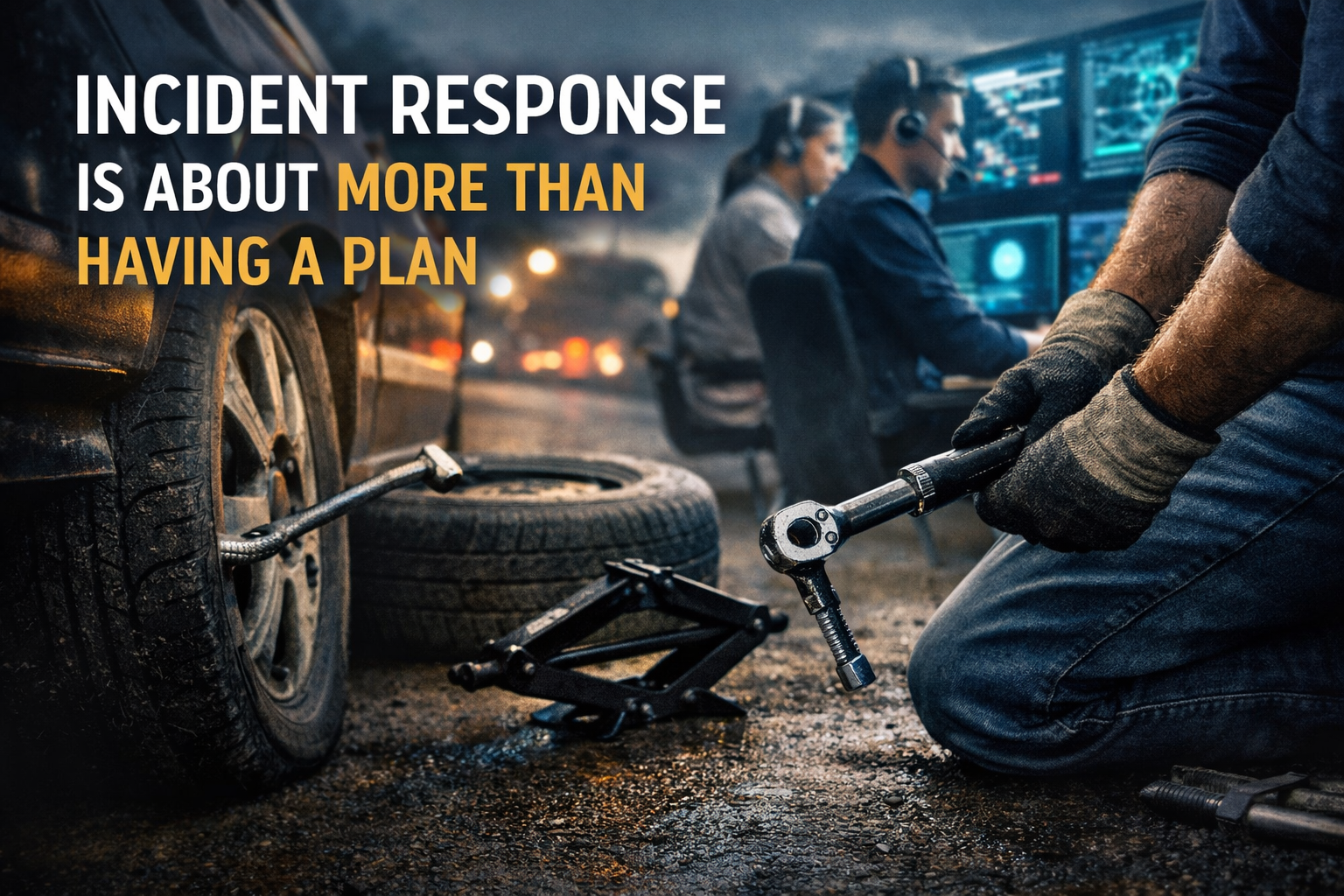
Incident Response is about more than having a plan
Follow us


When the Tool Fails: What a Tire Blowout Taught Me About Incident Response
Last week, I had outpatient surgery. On the way home, while I was asleep and still recovering, my wife had a tire blowout.
She safely pulled over at a nearby gas station, and I got out to handle what should have been a simple tire change. We had the jack. We had the spare tire. We had the lug wrench that came with the vehicle.
What we did not have was a tool strong enough to do the job.
As I tried to loosen the lug nuts, the wrench began to bend. In that moment, the lesson was immediate: having the “required” equipment is not the same as being truly prepared. Thankfully, a passerby stopped and had the right tools to help us get safely back on the road.
That experience stayed with me because it closely mirrors what happens during real cybersecurity incidents.
Having a plan is not the same as being ready
Many organizations have an incident response plan. They can point to documented procedures, defined roles, communication workflows, and technical controls. On paper, everything appears to be in place.
But when a real incident happens, the real question is not whether the plan exists.
The real question is whether the organization can execute under pressure.
Incidents do not happen at convenient times. They happen during leadership absences, staffing shortages, major business initiatives, holidays, personal emergencies, and moments when attention is already divided. They happen when people are tired, stressed, distracted, or managing multiple priorities at once.
That is why incident response is not just about documentation. It is about readiness.
Why real-world readiness matters
A written plan is important, but it only takes you so far. True readiness means understanding whether your people, processes, and tools will actually hold up when conditions are less than ideal.
It means validating that:
- your escalation paths are clear
- your decision-makers know their roles
- your communication expectations are understood
- your tools work when you need them
- your teams can coordinate under stress
In other words, it means proving that your response capability functions in the real world, not just in a policy document.
Why tabletop exercises matter
This is one of the clearest reasons tabletop exercises are so valuable.
Tabletops help organizations move beyond assumptions and test how they would actually respond to a crisis. They reveal gaps in coordination, process, communication, tooling, and decision-making before those weaknesses are exposed during a real event.
They also help leadership teams understand an important truth: resilience is not built by writing a plan once and putting it on a shelf. It is built through validation, repetition, and practical preparation.
A written plan may check a compliance box.
A tested and practiced response capability builds confidence and resilience.
The bottom line
Many organizations believe they are prepared because the required pieces are technically in place. But just like the manufacturer-provided lug wrench that bent when it mattered most, not every control or process will perform the way you expect under real pressure.
That is why incident response readiness must go beyond documentation. It requires practical testing, strong leadership alignment, and the confidence that your team can execute when the stakes are high.
How Iron Wing Security Can Help
At Iron Wing Security, we help organizations strengthen incident response readiness through practical planning, leadership-focused tabletop exercises, and real-world preparation strategies that go beyond compliance.
If your organization has an incident response plan but has not tested whether it will work when the pressure is on, now is the time to start.
Connect with Iron Wing Security to build an incident response capability that works in the real world, not just on paper.

